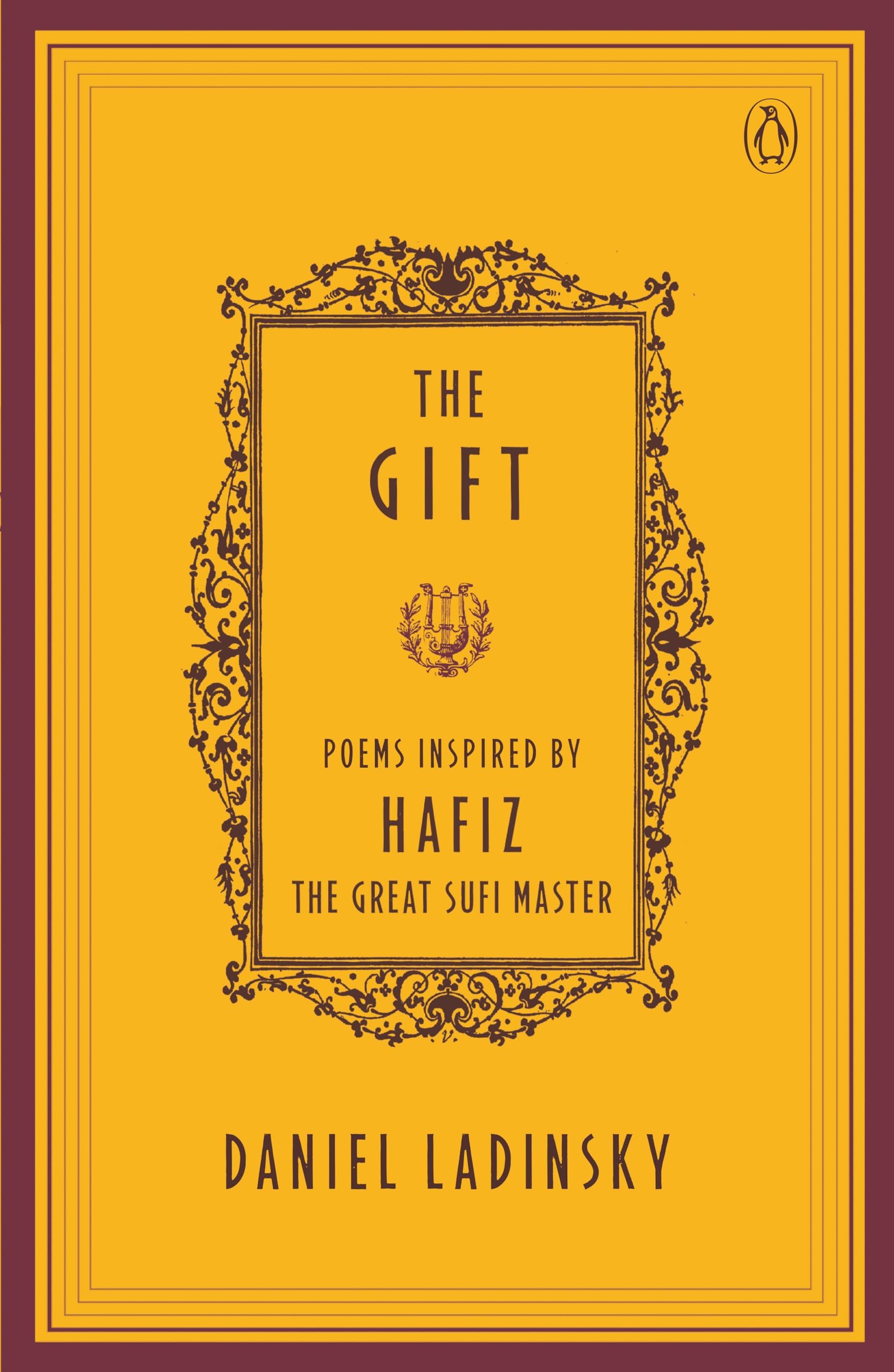
The Gift
Product ID: 225614
Daniel Ladinsky’s 250 unforgettable lyrical poems are inspired by the cherished verse of Hafiz, one of the greatest Sufi poets of all time. More than any other Persian poet, Hafiz expanded the mystical, healing dimensions of poetry. Because his poems were often ecstatic love songs from God to his beloved world, many have called Hafiz the “Invisible Tongue.” Daniel Ladinsky’s poems are not translations in a literal sense. Rather than capture the form of a particular classical work, Ladinsky crafts poems that release the spirit of Hafiz based on his study of stories and poems attributed to the revered Persian writer. The Gift imparts the wonderful qualities of this master Sufi poet and spiritual teacher: encouragement, an audacious love that touches lives, profound knowledge, generosity, and a sweet, playful genius unparalleled in world literature. Review: This book is a 'Fraud'... perhaps not - This is my first Review ever on desertcart and I am doing this for the love of Hafiz. I am originally of Persian origin and a life long lover of Hafiz... Have visited his tomb and the beautiful city of Shiraz. For people who are looking for a perfect translation, let me tell you that this is not it, not even close. To translate Hafiz, is to try and reproduce Shakespeare in another language and have it somehow come out with the same texture for the modern age (perhaps impossible). So reading Hafiz in Farsi requires years and years of cultural, intellectual and spiritual studies. To me he was an enlightened artist that had walked the esoteric Sufi path to full and authentic comprehension/liberation, in the process one can sense his love for existence and connection to the source (his own being). It feels like he had reached a place where like any great artist he had the necessary tools developed physically/mentally/intellectually to be able to translate his mystical experiences fluently and effortlessly into an external art form (in his case lyric poetry and who knows what else). I am explaining my understanding of him/her to make a point here. Mr. Ladinsky has somehow connected to the essence of Hafiz. In order to comprehend Hafiz in another language (and a whole different time/setting), one has to somehow try the impossible and reproduce the texture by trying to remove vague cultural, intellectual and spiritual references with ideas and thoughts that resonate with people today. Ladinsky has tried and somehow succeeded with giving us a glimpse (just a glimpse) of Hafiz and his loving/playful spirit. In my opinion, this book is mainly an intro to Hafiz, but even an intro is enough to open the door for those that like to venture deeper. In Iran Hafiz (or Hafez) and his main and perhaps only book 'Divan' is read like an Oracle (like the I Ching) - with intention and perhaps a lingering question one opens up to a page to receive his guidance. Well this book, carries the same fire if you're able to get past your ideas of right and wrong and just tune into it. For many Iranians (lots of my own friends), this book brings up a lot of challenges and I can understand that because it's so different from the original, but yet if you are able to realize that his poetry was from over 600 years ago, from a time when the culture was so different and language was a lot more evolved, than maybe you can put into context what this book is actually doing. And yes, language was more evolved, just look at the older writings by poets and writers and it should be obvious (that's a whole other subject). Mr. Ladinsky, has tried his best and this seems like the only book so far that allows one to get a glimpse of Hafiz in the english language, but he also does fall short in many aspects obviously (There probably isn't anyone that could perfectly translate Hafiz, even in Iran people argue about the deeper meanings of most of his writings). Hafiz's words are from another dimension and brought to life in Farsi, so to truly feel Hafiz, one has to study Farsi. Review: Music of the Spheres - For me, Like many others who have read Dan Ladinsky's unique versions of Hafiz, I find them an ever fresh fountain. These poems hold the essence of experiential spirituality, the possibility of unlimited creativity, the ocean of love, the sweet agony of longing, and the unbearable joy of ectsasy. It is difficult to remember that these miraculous jewels sprang from a life (Hafiz's)that was not without difficulty. The images here are startling and often hilarious and irreverent. But I think that most important Hafiz expands our ability to imagine and understand God. I grew up as a fundamentalist Christian and it never occurred to me that God could be as tender as this, "When the violin can forgive the past It starts singing. . . . You will become such a drunk laughing nuisance That God will then lean down And start combing you into His hair." Here is Hafiz's breathtaking yet practical image of unconditional love, "Even after all this time The sun never says to the earth "You owe me." Look what happens with a love like that, It lights the whole sky." In GREETING GOD Hafiz exquisitely describes spiritual longing this way, ". . .Tonight there is a jeweled falcon singing In a blessed pain using the tongue of Hafiz." I have given more than a few copies of THE SUBJECT TONIGHT IS LOVE as gifts. Now I'll give the gift of THE GIFT. I am a singer and a songwriter and I hear songs in these poems. Thank you Dan Ladinsky! You are like the "jeweled falcon" singing with "the tongue of Hafiz." Many blessings David Bankston, DMA
| Best Sellers Rank | #104,698 in Books ( See Top 100 in Books ) #19 in Sufism (Books) #35 in Middle Eastern Poetry (Books) #153 in Religious Poetry (Books) |
| Customer Reviews | 4.7 out of 5 stars 1,014 Reviews |
D**N
This book is a 'Fraud'... perhaps not
This is my first Review ever on Amazon and I am doing this for the love of Hafiz. I am originally of Persian origin and a life long lover of Hafiz... Have visited his tomb and the beautiful city of Shiraz. For people who are looking for a perfect translation, let me tell you that this is not it, not even close. To translate Hafiz, is to try and reproduce Shakespeare in another language and have it somehow come out with the same texture for the modern age (perhaps impossible). So reading Hafiz in Farsi requires years and years of cultural, intellectual and spiritual studies. To me he was an enlightened artist that had walked the esoteric Sufi path to full and authentic comprehension/liberation, in the process one can sense his love for existence and connection to the source (his own being). It feels like he had reached a place where like any great artist he had the necessary tools developed physically/mentally/intellectually to be able to translate his mystical experiences fluently and effortlessly into an external art form (in his case lyric poetry and who knows what else). I am explaining my understanding of him/her to make a point here. Mr. Ladinsky has somehow connected to the essence of Hafiz. In order to comprehend Hafiz in another language (and a whole different time/setting), one has to somehow try the impossible and reproduce the texture by trying to remove vague cultural, intellectual and spiritual references with ideas and thoughts that resonate with people today. Ladinsky has tried and somehow succeeded with giving us a glimpse (just a glimpse) of Hafiz and his loving/playful spirit. In my opinion, this book is mainly an intro to Hafiz, but even an intro is enough to open the door for those that like to venture deeper. In Iran Hafiz (or Hafez) and his main and perhaps only book 'Divan' is read like an Oracle (like the I Ching) - with intention and perhaps a lingering question one opens up to a page to receive his guidance. Well this book, carries the same fire if you're able to get past your ideas of right and wrong and just tune into it. For many Iranians (lots of my own friends), this book brings up a lot of challenges and I can understand that because it's so different from the original, but yet if you are able to realize that his poetry was from over 600 years ago, from a time when the culture was so different and language was a lot more evolved, than maybe you can put into context what this book is actually doing. And yes, language was more evolved, just look at the older writings by poets and writers and it should be obvious (that's a whole other subject). Mr. Ladinsky, has tried his best and this seems like the only book so far that allows one to get a glimpse of Hafiz in the english language, but he also does fall short in many aspects obviously (There probably isn't anyone that could perfectly translate Hafiz, even in Iran people argue about the deeper meanings of most of his writings). Hafiz's words are from another dimension and brought to life in Farsi, so to truly feel Hafiz, one has to study Farsi.
D**N
Music of the Spheres
For me, Like many others who have read Dan Ladinsky's unique versions of Hafiz, I find them an ever fresh fountain. These poems hold the essence of experiential spirituality, the possibility of unlimited creativity, the ocean of love, the sweet agony of longing, and the unbearable joy of ectsasy. It is difficult to remember that these miraculous jewels sprang from a life (Hafiz's)that was not without difficulty. The images here are startling and often hilarious and irreverent. But I think that most important Hafiz expands our ability to imagine and understand God. I grew up as a fundamentalist Christian and it never occurred to me that God could be as tender as this, "When the violin can forgive the past It starts singing. . . . You will become such a drunk laughing nuisance That God will then lean down And start combing you into His hair." Here is Hafiz's breathtaking yet practical image of unconditional love, "Even after all this time The sun never says to the earth "You owe me." Look what happens with a love like that, It lights the whole sky." In GREETING GOD Hafiz exquisitely describes spiritual longing this way, ". . .Tonight there is a jeweled falcon singing In a blessed pain using the tongue of Hafiz." I have given more than a few copies of THE SUBJECT TONIGHT IS LOVE as gifts. Now I'll give the gift of THE GIFT. I am a singer and a songwriter and I hear songs in these poems. Thank you Dan Ladinsky! You are like the "jeweled falcon" singing with "the tongue of Hafiz." Many blessings David Bankston, DMA
J**M
Quick and valuable read
I love this book. It’s not a sit down and read it through (unless you want to!). It’s a sit, turn to a random page, and read. Sit with it for a bit and think. It’s great poetry and always is insightful. I often purchase this as gifts for friends and is great to have on a “coffee table” or lamp stand.
A**E
Blessed Ruin: Lessons on the Stages of Love
Having already been enchanted by Daniel Ladinsky's previous rendererings of Hafiz in _I Heard God Laughing_ and _The Subject Tonight is Love_, Ladinsky's present effort is worthy of no less acclaim. In fact, his choices this time from the _Divan_(250 poems) bring home with exquisite precision that Hafiz, the Perfect Master is in fact, a Master of Love. The reader gets the clear message in Ladinsky's portrait that Hafiz has intermalized to perfection his teacher's (Mohammad Attar)lessons on the manifold levels of love and its demands: "I saw it was Hafiz who wrote all your notes of sadness, But also etched and gave you Every ecstatic wince of joy your face, body and heart has ever known." (p.38). This is no "New Age" nonsense, which at its worst hails the light and avoids the shadow, Hafiz (though seducing the beginner lover by his promises of sweetness and tenderness, that God could actually "become an infant in your arms"[p,56]) cautions that he "hold's the Lion's Paw whenever I dance."(p.57). Western culture has not received such lessons on divine love since Jesus and Plato, and unfortunately, the fresh images of their teachings on love have all been but lost to humanity, save a small remnant of sketches. Ladinsky's Hafiz both assures and challenges the seeker because any fully-alive being with such capacity for loving as Hafiz dwarfs our puny notions of western romantic love without shaming or condemning it. Only encouraging like a true teacher with compassion would: "You ask for a few words of comfort and guidance. I quickly kneel at your side offering you this whole book . . . Here's a rope, tie it around me, Hafiz will be your companion for life."(p83). Hafiz's language of love utilized the metaphor of his time and culture as Jesus incorporated the images of parable. Ladinsky courageously steps out of line (as surely did Hafiz) and takes the risk to be mundane without being irreverent when describing the labyrinth that is the heart: "There are different wells within your heart. Some fill with each good rain. Others are far too deep for that." (p76) Ladinsky's Hafiz teaches us of a divine being who walks among and talks with and celebrates his creation; yet challenges it to stretch beyond its boundaries of self-interest: " I want both of us to start talking about this great love. As if you , I, and the sun were all married and living in a tiny room, helping each other to cook, do the wash, weave and sew, care for our beautiful animals."(p.180). Ladinsky's fine portrait of this 14th century Perfect Master gives the West the certain bugal cry that God is not dead, but it is we who are dead to God. The success of this book will measure how many of us are indeed alive here, and how many are really interested in the more mature lessons of loving.
L**R
One need not be Christian or Muslim or whatever to appreciate his poetry with its deep feelings of connectedness and love of lif
The book has a lovely, reasonably long, introduction to Hafiz, his time, and fellow poets which helps to create an open and curious mind for the poems that follow. Although I was familiar with several Hafiz poems before, most of this book was new to me. It is a fairly thick book, with the poems spread lightly on the pages. Plenty of white space surrounds and set off the poems so that although there are many, many poems in the book, they are not crowded. Hafiz celebrates god in a way that is rich and exuberant. One need not be Christian or Muslim or whatever to appreciate his poetry with its deep feelings of connectedness and love of life. In fact, as a Buddhist, I find it is exactly that sensitivity to life, to joy, to the world around, and to other beings around us that offers the greatest illumination. This poetry is wonderful to read just before sleep, or any time, and is a fine addition to any library.
C**R
Absolutely beautiful poetic translation occasionally marred by silly attempts at contemporary relevance
Poetry is something I seldom read, but the range of philosophical and religious reflection in Hafiz' writing is amazing, delightful, and life-affirming. Not every poem is equally rewarding, but how could they be? The translations make these ancient short poems speak to the present day, but sometimes too much so--using terms that have only come into our language in the 20th or 21st centuries at times borders on "cutsie", which distracts from the true meaning. When Ladinsky sticks to standard and time-tested language and grammar, his translations have much deeper impact, for me anyway. I have not read other translations of Hafiz, but I imagine previous ones are full of "thee's" and "thou's", and less erudite perspectives. I highly recommend this book--for me is has more understanding and depth concerning daily living than Rumi, for instance. Just beware that there are some shockingly off-the-mark, if sincere, attempts to make this ancient poetry relevant to us now. Ladinsky apparently spent years working on this book, so my hat is off to his scholarship.
F**Y
I love The Gift of Hafiz by Daniel Landinsky I am ...
I love The Gift of Hafiz by Daniel Landinsky I am Persian and I love the poetry of Hafiz but the book Gift is the first book I read in English language translated by Daniel Ladinsky. As a Persian who is born and raised knowing the poetry of Hafiz by heart and in their original tongue, I really enjoyed reading the book and appreciated the interpretations and translation. Daniel Ladinsky is an American poet known as interpreter of mystical poetry born and raised in Saint Louise. He has said “the poet who I have worked most with is the 14th century Persian poet Hafiz. And Goethe has said, Hafiz has no peer. And I think Goethe knew what he was talking about”. Daniel Ladinsky has written many other books about Hafiz which are unique and many have come to know about this great Persian Master more glorious in the English language. In a rare interview on October 2013 with the Sun Magazine, Daniel Ladinsky shares about his spiritual longing, his encounter with a living saint in India who inspired him to work on Hafiz. In his preface of “The Gift” he invites us to join him in his fantastic applause of life and says “I vote to inscribe these words of Hafiz on every flag, church bell, temple, mosque, and politician’s brain: Dear ones, let’s anoint this earth with dance! I recommend the book "Gift" to everyone who enjoys poetry.
M**A
Do God a favor
Thanks to ladinsky for making the essence of Hafiz accessible to the English reader. For a select some, the purpose of Hafiz's poems is the supernal transportation that takes place in the heart, mind and soul of the seeker. A simple reader of Hafiz may appreciate a more mundane rendition; but a Lover comes to Hafiz to be lost in his drunkenness. ladinsky's interpretations above and outside of translations renders the Realm for the English reader. For hearts seeking higher service to the Friend this indeed is all that matters and yes, our hearts do joy at the criticism of those who yet court the kiss of the King for they are still engaged in the evolution back into essence and oh how the heart does dance at the thought of these. Wayfarer, do God, the "field of holiness" and all creation a favor, purchase this friend's every interpretation of Hafiz and devotionally devour massive morsels until the Final Friend causes YOU to spit out spontaneous sputterings of His own. But don't hurry or worry, for the process may take months or millennia but eventually all will evolve back home to Him. In joy enjoy in-Joy. Dear one read through that last line again, breathe through that last line again. It is far far deeper than most know.
N**H
Probably not accurate translation but good poetry
I have read in other reviews that this translation of Hafiz is far from accurate, and yet, the poetry has a wonderful mystical element. So, if you are looking for purity in the words of Hafiz, this may not be for you. If you are looking for mystical poetry, you may just enjoy it.
C**O
I've bought this multiple times for friends
Hafiz is such a good friend on the path. He makes our connection to God something both incredibly deep and transformative, as well as, light and hilarious at times. I love this. His writings for the most part, are short, one-page reflections that ask you to relax and enjoy for as long as it feels necessary to ruminate over his words. Great translator. Daniel Ladinsky (I think his name - and that's from memory, so just sayin' that it must be good) is a master of translating Hafiz' work.
I**L
♡♡♡♡♡
They say the taste of God-realization can't be shared in words. One has to taste it himself. Similarly, the purity of words of Hafiz is indescribable. One has to read it himself. Thus I am attaching snaps of few poems. Taste it yourself.
J**N
All Good!
Two thumbs up!
L**Y
one of my most treasured books...to be read over and over. it is the daily medicine for all the ills we inflict upon our own swe
a delicious chunky and priceless piece of heaven. i love this book so much everyone i love gets either a copy or one of the many inspiring "meditations" on life that this fine poetry book offers. hafiz (or rather ladinskys renderings of hafiz) is beyond measure the finest most down to earth poet to ever live. i am transported deeply and with gratitude into the bawdiness and sublime light, often at the same time, this is poetry to 'wake up' with, whether this be opening your eyes in the morning or devoting your heart to Love. Thank you that this exists to remind me always to return to truth, gratitude, love, courage, presence
Trustpilot
2 months ago
2 weeks ago