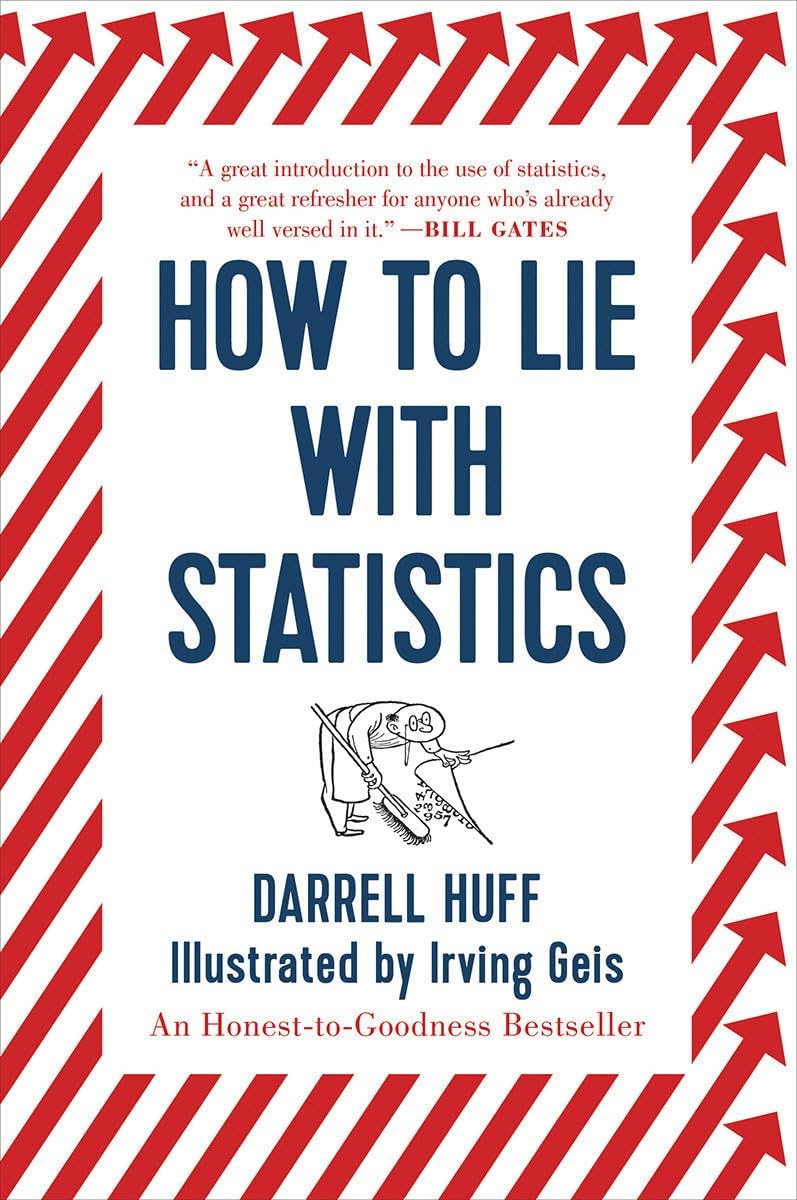
How to Lie with Statistics
Product ID: 2306522
Buy anything from 5,000+ international stores. One checkout price. No surprise fees. Join 2M+ shoppers on Desertcart.
Desertcart purchases this item on your behalf and handles shipping, customs, and support to Cote D' Ivoire.
Over Half a Million Copies Sold--an Honest-to-Goodness Bestseller Darrell Huff runs the gamut of every popularly used type of statistic, probes such things as the sample study, the tabulation method, the interview technique, or the way the results are derived from the figures, and points up the countless number of dodges which are used to full rather than to inform. Review: A classic book of mathematics in plain language - There's a reason this book has been in print for 70 years--it's THAT GOOD. The statistics used may be a bit dated, but are no less effective for that. Every example is carefully chosen to show how numbers can be used to obscure, mislead, and otherwise lie. Best of all, there is a discussion of how to recognize misleading statistics versus honest ones. This book was in my high school math teacher's classroom, and has been in mine as well. Anybody can understand it; anybody can "talk back" to statistics. Even if you're not a big fan of math or numbers, this is an excellent book. Review: A practical, interesting and entertaining view of statistics - How to Lie with Statistics by Darrell Huff is not a typical statistics book. The purpose of this book is to teach readers how to interpret statistics. Huff provides countless examples of how statistics can be misused to convey data. The examples are taken mainly from newspaper articles and magazines. The bottom line is that researchers and authors are often biased and present data to support their views. No background in statistics is necessary to understand the examples and explanations. An understanding of high school level algebra is sufficient to comprehend the concepts presented in this book. Huff addresses topics such as averages, graphs, sampling techniques, deviation and correlation. This book would be good supplementary material for a consumer education or introductory statistics course. Huff's examples are ideal for classroom discussion. How to Lie with Statistics provides a practical, interesting and entertaining view of statistics. Although the book was originally published in 1954, the examples are still relevant today. In fact, it is more important than ever before to be an educated consumer.
| Best Sellers Rank | #16,600 in Books ( See Top 100 in Books ) #3 in Business Statistics #5 in Probability & Statistics (Books) #8 in Statistics (Books) |
| Customer Reviews | 4.4 out of 5 stars 4,495 Reviews |
T**L
A classic book of mathematics in plain language
There's a reason this book has been in print for 70 years--it's THAT GOOD. The statistics used may be a bit dated, but are no less effective for that. Every example is carefully chosen to show how numbers can be used to obscure, mislead, and otherwise lie. Best of all, there is a discussion of how to recognize misleading statistics versus honest ones. This book was in my high school math teacher's classroom, and has been in mine as well. Anybody can understand it; anybody can "talk back" to statistics. Even if you're not a big fan of math or numbers, this is an excellent book.
S**A
A practical, interesting and entertaining view of statistics
How to Lie with Statistics by Darrell Huff is not a typical statistics book. The purpose of this book is to teach readers how to interpret statistics. Huff provides countless examples of how statistics can be misused to convey data. The examples are taken mainly from newspaper articles and magazines. The bottom line is that researchers and authors are often biased and present data to support their views. No background in statistics is necessary to understand the examples and explanations. An understanding of high school level algebra is sufficient to comprehend the concepts presented in this book. Huff addresses topics such as averages, graphs, sampling techniques, deviation and correlation. This book would be good supplementary material for a consumer education or introductory statistics course. Huff's examples are ideal for classroom discussion. How to Lie with Statistics provides a practical, interesting and entertaining view of statistics. Although the book was originally published in 1954, the examples are still relevant today. In fact, it is more important than ever before to be an educated consumer.
B**T
Influential book to me.
I'm a college student who had to buy this book for a math class. We had a list of books to choose from and I chose this because it seemed to be one of those interesting debunking type writing pieces that give an alternate perspective on something so commonly followed. With statistics, we see them everywhere and spewing from people's mouths constantly. But where do they come from and why are they unreliable and in what cases are they unreliable? Darrell Huff kind of hits all aspects of statistics, and is sure that he hasn't crossed his own lines of creating bias; throughout the book he addresses each side the story. What sides am I referring to? The statistician's point of view, whoever's hands it was transferred to thereafter, the media that project this news to viewers, and the viewers point of view. He does this all with such a sense of reliability, because he never fails to leave out an aspect that would undermine his conclusions. I found a lot of great information in this book, some that has reinforced my beliefs about statistics and others that have provided me with new views on information. With increasing amounts of information available, and that instant communication that allows us to share information faster, we need people to be reading more books like this so they avoid learning a bunch of value-less information from people who haven't "done their homework." Sometimes statistical deceit is unintentional, while other times it's deliberate. Huff examines each cases, and attempts to provide understanding to all of his readers as to how we can avoid this and the 5 questions we can ask ourselves when we approach information. If you've either: - Wondered about news information and how it's history has influenced citizens (and how it really still applies) - Needed refreshers on the importance of statistics as well as how to approach them - Struggled with reading statistics or producing statistics - Enjoyed being offered alternate perspectives on widely accepted practices like presenting information through statistics - Curious about where people get their information, and why they're quick to spew statistics like it's true knowledge THEN READ THIS BOOK! :)
J**G
Excellent, but dated.
This little book is a great piece to get one in the right mindset for consuming media, political propaganda, science, and more! While it is a lighthearted read, lacking in substantial statistical analysis, it does provide a basic breakdown of how statistics can be used to manipulate, fool, and lie (with oneself as a thinker, and with ones consumers). Even if a given thinker is not using any of the fallacies that this book discusses, it is worthwhile for a reader to maintain the spirit -the mindset- of this book, and always remain critical when reading data, science and statistics. You will probably be best served in reading this book if you already know a little bit about statistics (ie: the difference between mean, median and mode, and when one might use them), but some complementary google searching while reading can fill in the blanks for those less statistically inclined. Admittedly, it is a little bit dated, with most sources coming from a long time ago, and most references falling flat on their faces. This dated-ness doesn't take away from the content though, and should not dissuade you from getting a copy.
D**N
It's A Good Book!
It's alright. I haven't finished it, but it's pretty good. It has a narrative like form. The author essentially gives good examples. It's a great book, but it's a relaxed read instead of an intense read. The book has nice examples, although I have not read it fully yet, still reading it (amongst other books) and haven't been to impressed by it. I guess if you're looking to apply lying with statistics or spot it in the news or something more direct, this book isn't exactly for that. However, if you wanna know some useful facts about how people and corporations deceive with the use of false language statistics then I suppose it serves its purpose.
M**J
Great information, presented in a fun read, even for novices!
Despite having been written over half a century ago, "How to Lie with Statistics" is a timeless look at how statistics have been used to mislead or draw unsubstantiated conclusions. Ignoring the slightly dated examples- many references to the events of the 50's and monetary examples that are humorously off as a result of inflation, "How to Lie with Statistics" still has plenty to offer to readers in our fast-pace, data-driven world. Author Darrell Huff managed to create a wonderfully light and humorous read while still managing to convey a tremendous amount of information. This relatively short book is practically a quick introduction and handbook for many of the most common means of manipulating statistics. It is down-right amazing how many questionable practices you are able to spot after learning the content in this book. From tooth paste advertisements to election polls, the truly essential skills taught by this book help teach you how to dissect claims, and understand what is behind the marketing twists and biases. One of the most wonderful aspects of this work, is the ability to convey a tremendous amount of information in a way that any laymen would be able to pick up and understand. The topics covered include: how sampling introduces bias, the various ways of reporting "averages" (mean, median, mode), how advertisers pick and choose among statistics, unreported probable error, manipulation of graphs, irrelevant data, and (of course) correlation vs. causation. One might go so far as to say that this handbook guide is an advertiser's worst nightmare, pointing out the many ways that numbers are used to convince us of incorrect conclusions. While I certainly wasn't new to statistics, this book brought forth a breadth of information, presented in a fun, light-hearted way, and broken up with amusing illustrations. But, don't let its length or appearances fool you, the things you can learn are extraordinarily useful. I would highly recommend this book to a wide audience, anyone with a passing interest in how numbers are being used to deceive.
C**S
Entertaining book for those who have time to enjoy the stories and need only a very basic introduction
This is a useful book for those who have no familiarity with probability and statistics. The level of treatment is basic - no "equations" but concepts well explained. Inquisitive 9th graders should be able to understand it with no trouble. My complaint is the book is too simple. Less verbose with more insights on problematic applications would be good. For example, quoted probabilities for medical maladies frequently call for Bayesian concepts that are wrongly interpreted, often poor understanding of false positives/negatives. The abstract Bayesian concept would be a good one to explain in simple language (graphical explanation is elegant). Then there is also the issue of correlation and causation ... could be treated better. It's bad enough that rigorous experimental designs are difficult. Not understanding the impact of (independent, dependent) variables (or that a multivariate analysis correlation with a huge number of variables can be meaningless) is deadly. Granted, the book was written in 1954 however, probability and statistics has long been part of the human equation, and there is a clear need for everyone to have a better understanding (well stated by other reviewers). I suggest this book falls short, hence 4* (4* only because it is well written, my bias lower but wish to be objective). I read editorial book reviews and 5* and 1-2* star reviews before buying. In this case should have paid more attention to the low side comments that on rereading had clues. Buried were sentences I wish I'd seen before buying.
M**E
an all-time classic
Great little book. Catchy, slightly misleading title. Thed author does not show you how you can lie with statistics. This book illustrates how statistics can be manipulated to conform with someone's preconceived conclusions or messages. Advertising, of course is full of this sort of shenanigans, and the world of advertising provides numerous examples of misleading statistics. Because of the sorts of abuse outlined in this book, statistics fare often suspect, mistrusted in our day-to-day existence. This is unfortunate, as the basic quantification of various phenomena is essential to our understanding of the world around us. All the more reason to read this book carefully: you'll be better equipped to spot the intentional (and to be fair, sometimes unintentional) misuse of statistics and the misuse of analysis and logic. Highly recommended, and truly a classic "caveat emptor."
J**H
Good product
Quite an old book, however still very relevant
K**E
How to Lie with Statistics learn the tricks.
it was written in the 1940ish . but its still relevant
A**I
Must-have in today's world
It's a complete must-have in today's world. We live surrounded by news and articles full of statistics and graphs that seem convincing, but in reality, many can be misleading, not because of wrong data, but because of how it is presented. This book provides indispensable knowledge for better understanding the statistics used in media and knowing how to detect lies or misdirections.
N**5
Une lecture très agréable et instructive
Je recommande ce livre, très facile à lire (d'un côté grâce à la taille de l'écriture pas trop petite et à une mise en page aérée, d'un autre côté grâce au style de l'écrivain, qui rend accessible au public un contenu pas toujours facile à comprendre). Concernant la commande sur Amazon, la livraison a été super rapide malgré les conditions actuelles.
A**E
Old, but still relevant. Not a modern read.
This book is old (50-ies) but its still correct. I remembered the title from my long time ago teacher and always wanted a copy. Read it in one go, doesnt go very deep. Wasnt really worth the money, you should get something modern instead.
Trustpilot
2 weeks ago
1 day ago